
Introduction
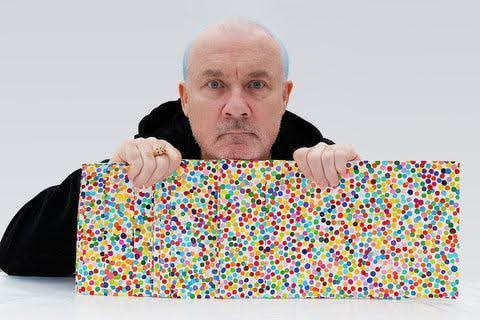
Death is a central theme lingering in Damien Hirst’s art. Now, it’s making an appearance in an all-new way.
In May of 2025, in an interview with the London Times, Hirst announced an unprecedented artistic and legal experiment: a plan to “create” artworks for 200 years after his death. He calls them “posthumous paintings;” his manager calls them “preposterous paintings.”
To execute this plan, Hirst plans to “fill up” 200 notebooks, each corresponding to a year after his death. The idea is to have a certificate that says “Year One after Damien dies: you’ve got the right to make this sculpture and you can trade the certificate before it isn’t made.” These notebooks will contain designs that are similar to instructions. Buyers will be able to create and sell the designs in the notebooks under Hirst’s name, and his heirs will sign those artworks. Hirst has proposed for some of the art pieces to be dated historically: “I had an idea for a sculpture of a piggy in formaldehyde back in 1991 that I never made. So, if that was in book 145 you could make that pig [145 years after his death] and date it 1991.” This dating scheme is bound to create a tremendous amount of practical hurdles for art professionals and institutions (archiving, provenance, chronological exhibitioning being some of the most obvious ones). Hirst has already faced backlash for back-dating his sculptures of animals in formaldehyde tanks to the 1990s when they were, in reality, produced recently.
Though this whole arrangement may sound unusual, delegated creation has long been utilized in Hirst’s operations. At his peak, Hirst had 350 employees; now, despite downsizing to 150, he reports producing “three or four times the amount of art.” This industrial approach to art creation, where conception and execution are separated, provides crucial context for Hirst’s posthumous plans.
The fact that Hirst has long directed others to execute his works settles some important legal and market questions that would have otherwise arisen. For one, it shows that collectors and the art market generally have already accepted Hirst works physically created by assistants and value them accordingly. Secondly, Courts examining the authenticity of posthumous Hirst works will find decades of precedent for instruction-based creation under his name.
However, there are important legal questions that still remain, particularly with regard to copyright. Since the certificates will be tradeable before the works are made, the instructions risk becoming widely accessible, giving rise to a situation where multiple parties could execute the same work. Such situations would especially bring copyright questions to the fore.
The Workability of Hirst’s Plan Under UK Copyright Law
There are several ways in which UK courts could interpret Hirst’s posthumous art scheme. Which one they will eventually opt for will depend on two factors: (1) the level of detail in Hirst’s instructions, and (2) the specific legal structures he establishes before his death. The key interpretive possibilities are as follows.
Option 1: Hirst as Copyright Owner
The most straightforward (but least workable) reading would be for Hirst himself to retain copyright. Firstly, a basic problem is that under UK law, where Hirst is a citizen, copyright protection subsists for the artist’s life plus 70 years. Hirst’s 200-year plan thus extends 130 years beyond legal copyright protection. If the works are attributed to Hirst, all of the works after notebook 70 would be void of copyright protection, falling directly into the public domain.
A second, and more conceptual, problem concerns authorship. A deceased Damien Hirst cannot be the initial copyright owner of works created after his death. While this sui generis legal question has not yet arisen in UK courts, recent AI-generated art cases and animal-generated art cases in the US have clarified that the first owner of copyrights has to be a natural person. Until proven otherwise, it is safe to assume UK courts will take the same approach. Posthumous Hirst works would therefore lack a living author capable of holding the copyright at their inception.
Option 2: Separate Copyrights — Hirst in the Notebooks, Buyers in the Executed Works
If Hirst cannot be the first-owner of copyrights in works created after his death, the second option would be for Hirst (and after his passing, his estate) to hold copyright in the notebooks and the buyers to hold copyright in the specific executed pieces.
This structure fails for three interconnected reasons. First, the idea-expression dichotomy: it is a fundamental tenet of copyright law that it protects specific expressions, not ideas. Under this perspective, Hirst’s ideas would not be protectable, only the physical notebooks that represent the ideas would enjoy protection as original literary or artistic works for 70 years after his death. Once that term expires, however, their contents would enter the public domain. This means that if these concepts become known (in an authorized or unauthorized way), nothing would prevent others from executing their own versions using Hirst’s instructions. This would not be a desirable result as it offers limited commercial protection, fails to preserve the exclusivity Hirst’s estate would likely intend, and creates authentication issues.
Option 3: Fragmented Copyrights in the Executed Works
Another possibility is that Hirst and the buyers hold distinct copyrights in separate elements of the finished works. Where the buyers’ creative input is individually identifiable, they could own copyright in those discrete aspects. A shortcoming here is that holders of fragmentary copyrights cannot prevent the copying of the entire work, only the replication of their own identifiable contribution.
Kogan v. Martin (2019), where the UK Supreme Court enunciated a four-limb test for joint authorship, might prove helpful for assessing whether Hirst’s buyers would end up with joint ownership or fragmented ownership. The dispute concerned the screenplay for the film “Florence Foster Jenkins,” written by Nicholas Martin. At the start of the project, he was in a relationship with opera singer Julia Kogan, who provided expertise on opera, character development, and significant plot elements. After their breakup, Martin took Kogan out of the script. The court found Kogan as a joint author, with the help of the following four factors.
- Collaboration – the work must result from a common design or shared creative process; the purpose is to distinguish a joint work from a unitary work.
- Holistic authorship – courts should look beyond “who did the writing?”; creative conception and expressive realisation can be divided among collaborators.
- Free and creative choices – each party’s contribution must involve expressive, original decision-making rather than mere skill or labour.
- Non-distinctiveness of contributions – if each author’s contribution is inseparable from the whole, joint ownership is appropriate; if distinct, separate copyrights apply instead.
Daniela Simone notes that though Kogan skips “significant contribution” as a requirement within the new framework, significance of the contribution is likely to remain relevant (especially because joint authors might be entitled to unequal shares of the copyright interest).
Applying Kogan to Hirst’s scheme reveals a fundamental obstacle to joint ownership: given the final work will be based on instructions, it is likely that the buyers’ additions will be well-defined and sufficiently distinct from the instructions, and hence they will hold copyright in the specific executional details they introduced rather than the full work. These fragmentary rights would be narrow and difficult to enforce against, say, people who try to make replicas based on the final products.
Still, Kogan suggests that courts are increasingly open to recognising collaborative creativity in complex authorship settings, a trend that could favour Hirst’s executors if the works demonstrably reflect a shared creative process. The most beneficial scheme for Hirst and his future buyers collectively would hence be joint ownership, and if Hirst’s directions leave room for interpretative discretion, the buyers’ input might qualify as creative expression, strengthening a claim to full joint authorship.
Option 4: Hirst and Buyers as Joint Authors of Final Work
This brings us to the last option: if Hirst is not capable of holding copyright posthumously, and if 130 years worth of artworks will be virtually unprotectable in all other scenarios, the most viable solution is for the buyers to qualify as joint authors of the finished pieces. This would allow copyright protection to subsist for the buyers’ life plus 70 years.
Under UK and EU law, copyright requires originality, meaning the work must be the author’s “own intellectual creation.” UK courts have explicitly rejected an artistic merit requirement for the originality test. To establish joint authorship, each contributor must make a “significant and original contribution,” and their combined input must reflect a single, collaborative work of which each party is entitled to the whole.
Historically, courts set a high bar for joint authorship. In Hadley v. Kemp (1999), Gary Kemp (the guitarist of Spandau Ballet) had written “True” and held sole copyright. After the song’s success, Steve Norman (the group’s saxophone player) sued for joint ownership, in lieu of his distinctive saxophone solo in the song (sixteen bars constituting 9% of the song). The court held that performing a part, even with some improvisation, does not necessarily create joint ownership. Under this logic, Hirst’s buyers would have had no prospect of attaining joint ownership in the posthumous works.
Fisher v. Brooker (2007) marked a significant departure from this long-standing high standard.
There, Matthew Fisher’s eight-bar organ solo in “A Whiter Shade of Pale” (just 5% of the song) was deemed sufficiently original to make him a joint author, earning him a 40% copyright share. Courts have since followed this broader view of collaborative creativity. Applied to Hirst’s scheme, buyers could qualify as joint authors if, in executing Hirst’s instructions, they exercise original choices that substantially shape the expressive outcome. However, without seeing the level of detail with which Hirst’s instructions will be written, conclusive presumptions cannot be made.
As Luke McDonagh explains, Fisher ultimately holds that a musician who adds sufficient originality to an existing composition during the performance and recording process will be a joint author of the resulting arrangement. It could be helpful to think of Hirst as analogous to the composer, providing the conceptual “score,” while the buyers act as performing musicians, whose creative interpretation is explicitly asked, and transforms the composition into an arrangement. Both are indispensable to the final product, so they share one joint tenancy in the form of copyright in the final works.
Thinking of Trademarks
If all else fails in copyright protection, one way to retain control over the works would be to utilise trademark protection in the “Damien Hirst” name as a mark. If properly maintained, the Hirst name could theoretically provide perpetual protection. As Alexa Donovan mentions, there may not even be a market for Hirst’s art by then – it is hard to see centuries down the line. Nevertheless, it is highly unlikely that the Hirst name will fade so aggressively as to eliminate the premise of trademark protection.
Notably, trademark protection (which only gives rights to use a mark to identify source of goods) is not as extensive as copyright protection (which provides a property right “in gross” to control the reproduction, making of derivative works, distribution, and public performance/display of the copyrighted work). However, Hirst might eventually have to opt for this lower level of protection given the unique circumstances. Since a dead person cannot hold copyright, and buyers following clear-cut instructions are unlikely to achieve joint authorship, trademarks may offer the most prospectively feasible solution.
While trademark protection would not prevent the copying of the artistic works themselves, it would prohibit others from selling replicas under the “Damien Hirst” name. This would address the scheme’s core vulnerability: without some form of protection, anyone accessing the instructions could create and market identical works as authentic Hirsts, destroying the certificates’ and resulting works’ commercial value.
Finally, one must keep the value of the public domain in mind. Copyright protection is finite because it is recognised that there is value in nurturing the “building blocks of creativity.” Although this is not the place to delve into a policy debate, courts might have this in mind while deciding such a novel scheme for perpetual post-death creation. There is, of course, always a balance to be struck between the public interest and authors’ rights.
Conclusion
Hirst has built his career on executing audacious and provocative ideas that other artists might only contemplate. Hirst has said, “So I had an idea of a machine that makes paintings, and it’s infinite. It just keeps making them.” Although he never made that machine, the posthumous art scheme comes close to it.
At age 60, Hirst has said he’s worried about his sons “inheriting a nightmare” which is why he is “really looking at how to get [his] affairs in order.” However, the legal analysis above suggests that his posthumous art scheme generates a whole new set of legal challenges that must be taken into account and thought thoroughly with legal counsel.
The most beneficial way for Hirst to manage the plethora of copyright challenges seems to be for him and the buyers to be considered joint authors, allowing for the copyright protection to subsist for the buyers’ life + 70 years. However, whether courts will actually embrace this novel application of joint authorship to posthumous, instruction-based art remains untested and uncertain. In the absence of copyright certainty, trademark protection remains reliable: protecting the “Hirst” name with a trademark, while unable to prevent copying, would prohibit unauthorized sales using Hirst’s name, preserving the commercial exclusivity of the scheme and authenticity of the artworks.
Ultimately, Hirst’s “preposterous paintings” serve as a valuable experiment, testing the boundaries of intellectual property law and forcing us to reconsider fundamental assumptions about authorship, creativity, and the temporal limits of artistic control.